

James Bond may have had a license to kill, but EMS providers have the knowledge and training to save lives. What can a 1965 spy thriller teach us about diving emergencies, respiratory physiology, and patient assessment? More than you might think.
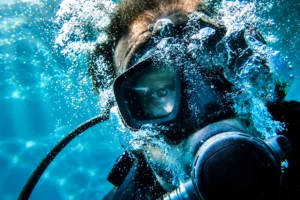
When most people think about James Bond, they picture fast cars, sophisticated gadgets, beautiful locations, and a perfectly tailored tuxedo. But in the 1965 James Bond film Thunderball, starring Sean Connery, 007 spends a surprising amount of time underwater.
Between the scuba diving, underwater battles, spearguns, and sophisticated breathing equipment, Thunderball offers EMS providers an opportunity to explore some fascinating medical emergencies.
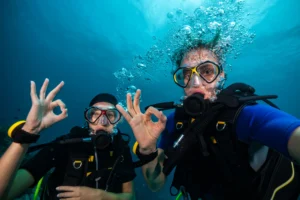
Couple of scuba divers showing OK signal underwater
Now, I doubt Bond ever stopped in the middle of an underwater fight to assess his opponent’s lung sounds or obtain a SAMPLE history. But if we look past the Hollywood action, we find several potentially life-threatening emergencies that EMTs and paramedics should understand.
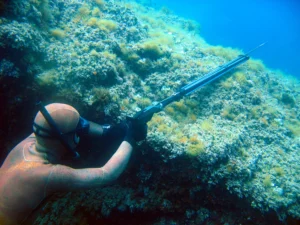
diver on a rock waiting for the fish with rifle
So grab your dive gear, check your oxygen supply, and let’s see what 007 can teach us about emergency medicine.
1. Decompression sickness: When coming up too fast can bring you down
One of the most memorable aspects of Thunderball is the extensive underwater diving. Bond and his adversaries maneuver beneath the surface using compressed-gas scuba equipment.
What Hollywood rarely shows is the potentially serious consequence of ascending improperly after a dive.
Decompression sickness (DCS) occurs when dissolved inert gases, primarily nitrogen, form bubbles in body tissues or blood as ambient pressure decreases.
Under increased pressure, more nitrogen dissolves into the body’s tissues. During a controlled ascent, nitrogen is gradually eliminated through respiration. However, excessive inert-gas loading or insufficient decompression may allow bubbles to develop.
These bubbles can produce a range of symptoms, including:
-
Joint or muscle pain, often called the bends
-
Numbness, tingling, or weakness
-
Dizziness, vertigo, or difficulty walking
-
Unusual fatigue
-
Confusion or other neurologic changes
-
Respiratory distress in severe cases
Symptoms may begin shortly after surfacing or develop hours later.
EMS Clinical Pearl: A patient presenting with unexplained neurologic symptoms after scuba diving should be evaluated for decompression illness (DCI), which includes decompression sickness and arterial gas embolism, even if the patient reports following proper diving procedures.
Treatment includes high-concentration oxygen, appropriate supportive care, and urgent medical evaluation with consideration for hyperbaric oxygen therapy.
2. Arterial gas embolism: A different kind of bubble trouble
While decompression sickness involves bubbles forming from dissolved gas, another dangerous diving emergency occurs when gas enters the arterial circulation.
An arterial gas embolism (AGE) may result from pulmonary overexpansion injury during ascent.
Remember Boyle’s law?
P₁V₁ = P₂V₂
As ambient pressure decreases, the volume of a gas increases, assuming temperature remains constant.
A diver who breathes compressed gas at depth and then ascends while holding their breath risks lung overexpansion as trapped gas expands. This can rupture alveolar structures and allow air to enter the pulmonary vasculature.
Once air enters the arterial circulation, it may travel to the brain or coronary arteries, producing catastrophic consequences.
Signs and symptoms may include sudden loss of consciousness, seizures, focal neurologic deficits, confusion, or cardiovascular collapse, often during ascent or within minutes of surfacing.
Unlike a typical Hollywood action scene, a real diver experiencing an AGE may suddenly become critically ill without any visible traumatic injury.
EMS Clinical Pearl: Sudden stroke-like symptoms immediately after surfacing from a dive should raise strong concern for arterial gas embolism. Even a relatively shallow compressed-gas dive can produce this emergency.
Management includes high-concentration oxygen, airway and hemodynamic support, rapid transport, and early consultation regarding hyperbaric treatment. Do not delay transport for a prolonged scene evaluation.
3. Bond’s breathing apparatus: When oxygen becomes your most valuable gadget
One of the more memorable gadgets in Thunderball is Bond’s miniature underwater breathing device.
It is the kind of equipment that makes you wonder whether Q Branch should have consulted a respiratory therapist before designing it.
For EMS providers, the device introduces several important questions.
How much breathable gas is available? What happens when the supply fails? How does increasing depth affect gas consumption? And what happens when a diver cannot ventilate adequately?
As a diver descends, ambient pressure increases. With conventional open-circuit scuba equipment, gas consumption measured in surface-equivalent volume increases with depth.
An equipment malfunction, insufficient gas supply, or inability to breathe can quickly become a life-threatening situation.
EMS assessment considerations
For any patient experiencing a diving-related respiratory emergency, evaluate respiratory rate and quality, oxygen saturation, mental status, chest discomfort, breath sounds, and evidence of pulmonary barotrauma.
Potential complications include hypoxemia, aspiration, pneumothorax, and arterial gas embolism.
Remember that a normal pulse oximetry reading does not exclude decompression illness or arterial gas embolism.
4. Drowning: Not every rescue ends when the patient reaches the surface
Imagine one of Bond’s underwater adversaries losing their breathing apparatus during a struggle.
The individual becomes disoriented, begins inhaling water, and is eventually pulled to the surface.
For EMS providers, this is where the movie ends and patient care begins.
Drowning is a process of respiratory impairment resulting from submersion or immersion in liquid. Its clinical consequences range from respiratory symptoms to profound hypoxia and cardiac arrest.
A critical distinction is that drowning-related cardiac arrest is generally hypoxic in origin.
The American Heart Association’s drowning resuscitation guidance emphasizes effective ventilation together with chest compressions when cardiac arrest occurs after drowning.
EMS treatment priorities include ensuring scene and rescuer safety, rapidly assessing responsiveness and breathing, providing effective ventilations when indicated, administering oxygen, beginning CPR with breaths and compressions for cardiac arrest, and managing hypothermia or associated trauma.
Patients with persistent coughing, respiratory distress, abnormal oxygenation, or altered mental status require prompt medical evaluation.
EMS Clinical Pearl: In cardiac arrest following drowning, start CPR with rescue breaths and chest compressions before applying the AED. Use the AED as soon as it is available once CPR has started.
5. Underwater combat: Trauma doesn’t stop at the shoreline
Perhaps the most dramatic scene in Thunderball involves a large underwater battle featuring divers armed with spearguns and other weapons.
It looks exciting on screen, but consider what EMS providers could encounter following such an incident.
Penetrating chest injuries, uncontrolled hemorrhage, pneumothorax, traumatic brain injuries, and blast-related injuries are all possible.
There is also the additional complication of treating trauma in a patient who may simultaneously be experiencing hypoxia, hypothermia, or decompression illness.
Take a penetrating chest wound, for example.
Your priorities still include hemorrhage control, assessment of respiratory compromise, appropriate management of open chest injuries, and rapid transport. However, in a recently surfaced scuba diver, chest pain and shortness of breath could also indicate pulmonary barotrauma.
Not every patient with chest pain after diving has a traumatic chest injury, and not every respiratory emergency after diving is decompression sickness.
The mechanism, diving history, and clinical presentation all matter.
6. The EMS assessment: Questions every provider should ask
Unlike a typical medical emergency, a diving-related illness requires specific historical information.
In addition to your normal primary and secondary assessments, determine:
-
How deep did the patient dive?
-
How long was the patient underwater?
-
How many dives were completed?
-
What breathing gas was used?
-
How quickly did the patient ascend?
-
Were decompression stops completed?
-
When did symptoms begin in relation to surfacing?
-
Did the patient experience equipment problems, breath-holding, or an uncontrolled ascent?
Whenever possible, obtain the patient’s dive computer, diving log, and information from their dive buddy.
These details may be valuable to the emergency department and hyperbaric medicine specialists.
EMS management priorities
For suspected decompression illness, follow local protocols and medical direction while emphasizing:
-
Airway and ventilation: Support inadequate respiratory effort and protect the airway when necessary.
-
Oxygenation: Provide 100% oxygen when feasible using an appropriate delivery device. Suspected DCI requires urgent evaluation even if symptoms improve with oxygen.
-
Neurologic assessment: Document mental status, strength, sensation, coordination, and focal deficits.
-
Circulatory support: Obtain vascular access and administer fluids when clinically indicated, avoiding unnecessary fluid overload.
-
Positioning: Generally maintain a comfortable, horizontal position when tolerated. Avoid routine head-down positioning intended to trap air bubbles.
-
Transport: Arrange urgent evaluation, coordinate with medical control and diving medicine specialists, and avoid unnecessary altitude exposure.
-
Reassessment: Continue serial neurologic, respiratory, and hemodynamic assessments.
Important: Do not attempt to recompress a patient by returning them underwater.
Divers Alert Network (DAN) provides 24-hour emergency consultation at +1-919-684-9111. This resource can assist EMS and receiving facilities with diving emergencies.
7. Your turn, 007: An EMS scenario
You are dispatched to a marina for a 42-year-old man who reports dizziness and weakness after scuba diving.
Your patient reports completing two recreational dives earlier in the day. His final dive reached approximately 90 feet. He surfaced about 20 minutes before EMS arrived.
He initially felt well but gradually developed dizziness, tingling in both legs, and difficulty walking.
Your assessment reveals:
Blood pressure
146/88 mmHg
Heart rate
108/min
Respiratory rate
22/min
SpO₂ (room air)
96%
GCS
15
Neurologic exam
Bilateral leg weakness
The patient asks whether he can simply go home and rest.
What is your greatest concern?
The post-dive neurologic findings demand urgent evaluation, high-concentration oxygen, and consideration of hyperbaric treatment. A normal SpO₂ does not exclude decompression illness.
Could this patient be suffering from dehydration or a vestibular disorder? Certainly.
But when a patient develops neurologic deficits following compressed-gas diving, decompression illness must remain high on your differential diagnosis.
Delaying treatment while waiting for symptoms to resolve could result in permanent neurologic injury.
8. The final mission: Think beyond the obvious
James Bond survived decades of impossible situations through a combination of intelligence, preparation, specialized equipment, and a little Hollywood magic.
EMS providers do not have the luxury of a movie script guaranteeing a successful outcome.
What we do have is education, clinical judgment, and the ability to recognize life-threatening emergencies before they become fatal.
The important lesson from Thunderball is not that every scuba diver will experience a diving emergency. It is that environmental conditions and exposure history can dramatically change the way we evaluate and treat our patients.
Dizziness following a dive may not be simple vertigo. Chest pain may not be cardiac in origin. New weakness after a dive should raise concern for decompression illness, including arterial gas embolism. Stroke and other causes remain in the differential.
Knowing what questions to ask and recognizing when a patient’s symptoms are connected to their environment can make the difference between a good outcome and a devastating one.
And that, Mr. Bond, is something worth remembering.
Continue Your Mission with DistanceCME
Whether you’re an EMT, AEMT, or paramedic, emergency medicine is constantly evolving. Maintaining your knowledge and clinical skills prepares you for the unusual calls that may come your way.
At DistanceCME, we provide flexible, online EMS continuing education to help you stay prepared while working around your schedule.
You may not need a tuxedo, a Walther PPK, or a license to kill, but you do need the knowledge and skills to save lives.
DistanceCME — Continuing education that fits your life.
References and further reading
Educational disclaimer: This article is intended for EMS education. Treatment decisions should follow current local protocols, medical direction, and applicable scope-of-practice requirements. The clinical scenario is fictional.
