
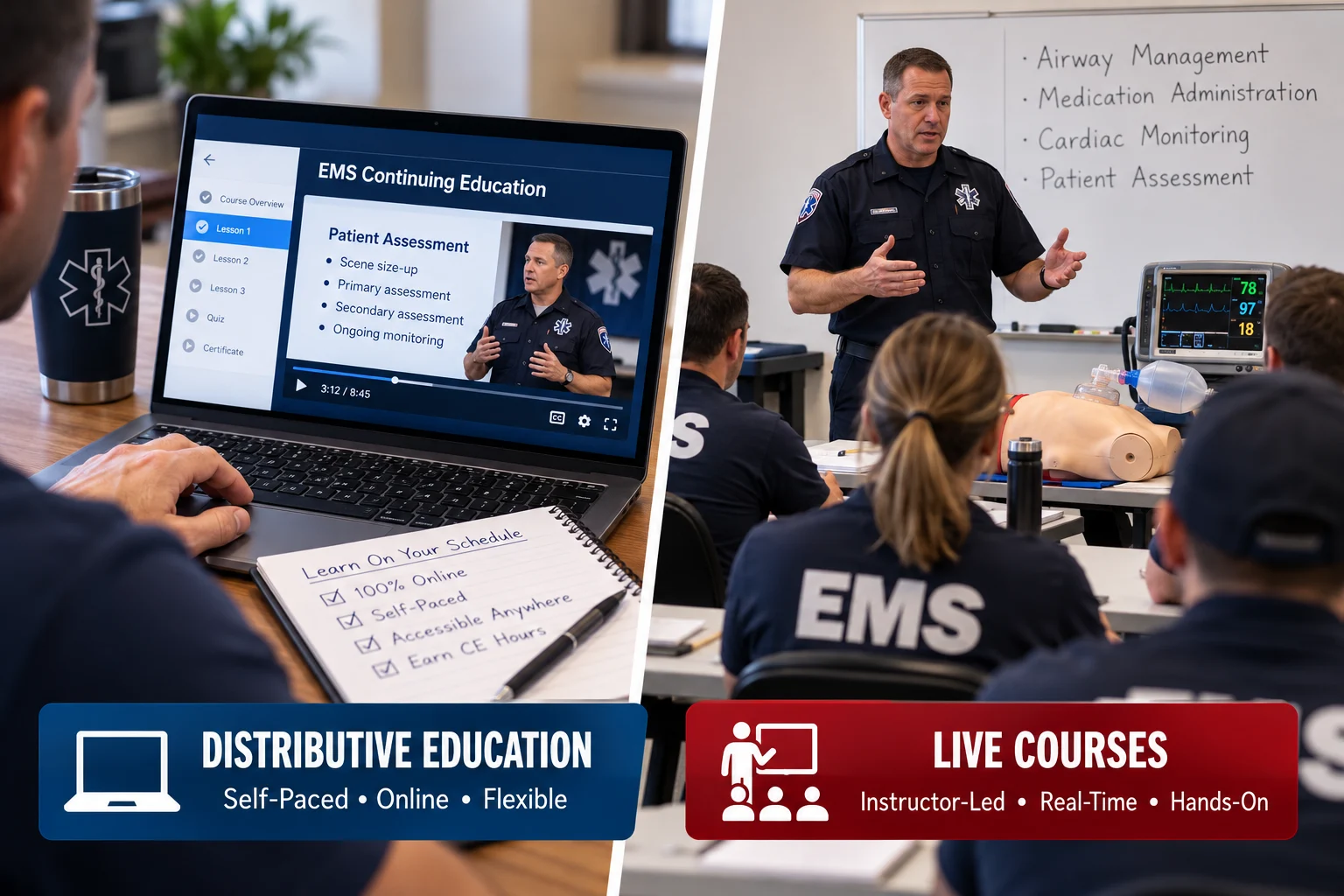
What Is Distributive Education in EMS CE, and How Is It Different From Live Courses?
“Distributive education” sounds like a term someone invented to make a simple idea sound complicated, and honestly, that’s not far off. Once you strip away the jargon, it describes something most EMS providers already understand intuitively: self-paced, on-your-own-schedule coursework. But the technical details of how distributive education actually functions within EMS continuing education, especially how it’s evaluated, tracked, and limited by state EMS offices, deserve a closer look than most explanations give it.
Defining Distributive Education Precisely
Distributive education, often labeled F3 in EMS continuing education frameworks, refers to structured coursework delivered without a live instructor present in real time. This includes recorded video lessons, written modules, interactive case studies, and assessments completed at whatever pace the individual provider sets. The defining trait isn’t the content itself, it’s the absence of live, real-time interaction with an instructor during the learning process.
This distinguishes distributive education from live formats like F5, or Virtual Instructor-Led Training (VILT), where a real instructor teaches in real time and students can ask questions as they arise.
How Distributive Content Is Evaluated for Accreditation
CAPCE, the Commission on Accreditation for Pre-Hospital Continuing Education, reviews distributive education content differently than it reviews live instruction. Because there’s no live instructor available to clarify confusing material on the spot, distributive courses are held to specific design standards, meant to ensure the content is clear, complete, and self-sufficient without real-time support. This typically includes built-in knowledge checks, clearly structured learning objectives, and assessment components that verify comprehension before the course counts as complete.
This is a more technical distinction than most explanations of “self-paced vs. live” cover, but it matters. A distributive course isn’t simply a recorded version of a live class, it’s built from the ground up to function without live interaction, which changes how the content has to be structured to remain effective.
Where State Rules Complicate the Picture
This is the part that trips up even experienced providers. Not every state treats distributive hours the same way. Some states cap the total percentage of continuing education hours that can come from distributive content, requiring a minimum portion to come from live instruction instead. Other states place no such limit and accept distributive hours at full value, hour for hour, identical to live instruction.
This means the same distributive course might satisfy 100% of a provider’s hours in one state and only a portion of the requirement in a neighboring state. Assuming distributive hours transfer identically across state lines is one of the more common and avoidable mistakes in EMS continuing education planning.
Distributive Education vs. Live Instruction: The Real Trade-offs
Neither format is universally better. Each serves a different situation.
When Distributive Makes More Sense
Straightforward review material, content that doesn’t change frequently, and situations where a provider’s schedule genuinely can’t accommodate a fixed class time all favor distributive coursework.
When Live Instruction Makes More Sense
Complex clinical updates, protocol changes with real nuance, and material where questions are likely to come up all benefit from having a live instructor available to address them in real time, something distributive content structurally cannot replicate no matter how well it’s designed.
Why Most Providers Need Both
Because state requirements often blend live and distributive hour minimums, and because different material genuinely suits different formats, most EMS continuing education plans end up using a mix of both rather than relying entirely on one format.
Getting Both Formats From One Accredited Source
DistanceCME offers CAPCE-accredited, 100% online EMS continuing education for EMR, EMT, AEMT, and Paramedic providers, through both live instructor-led F5 (VILT) sessions and self-paced F3 distributive coursework, so providers can build a continuing education plan that actually matches their state’s specific format requirements instead of guessing.
With more live course sessions than any other provider, DistanceCME gives providers a real choice between formats rather than forcing everyone into whichever option happens to be available.
Confirming Your State’s Format Requirements
Before building a continuing education plan around distributive hours, confirm exactly what percentage, if any, your state allows from self-paced content. Contact us and we’ll help you sort out the right mix of live and distributive hours for your specific recertification cycle.
