
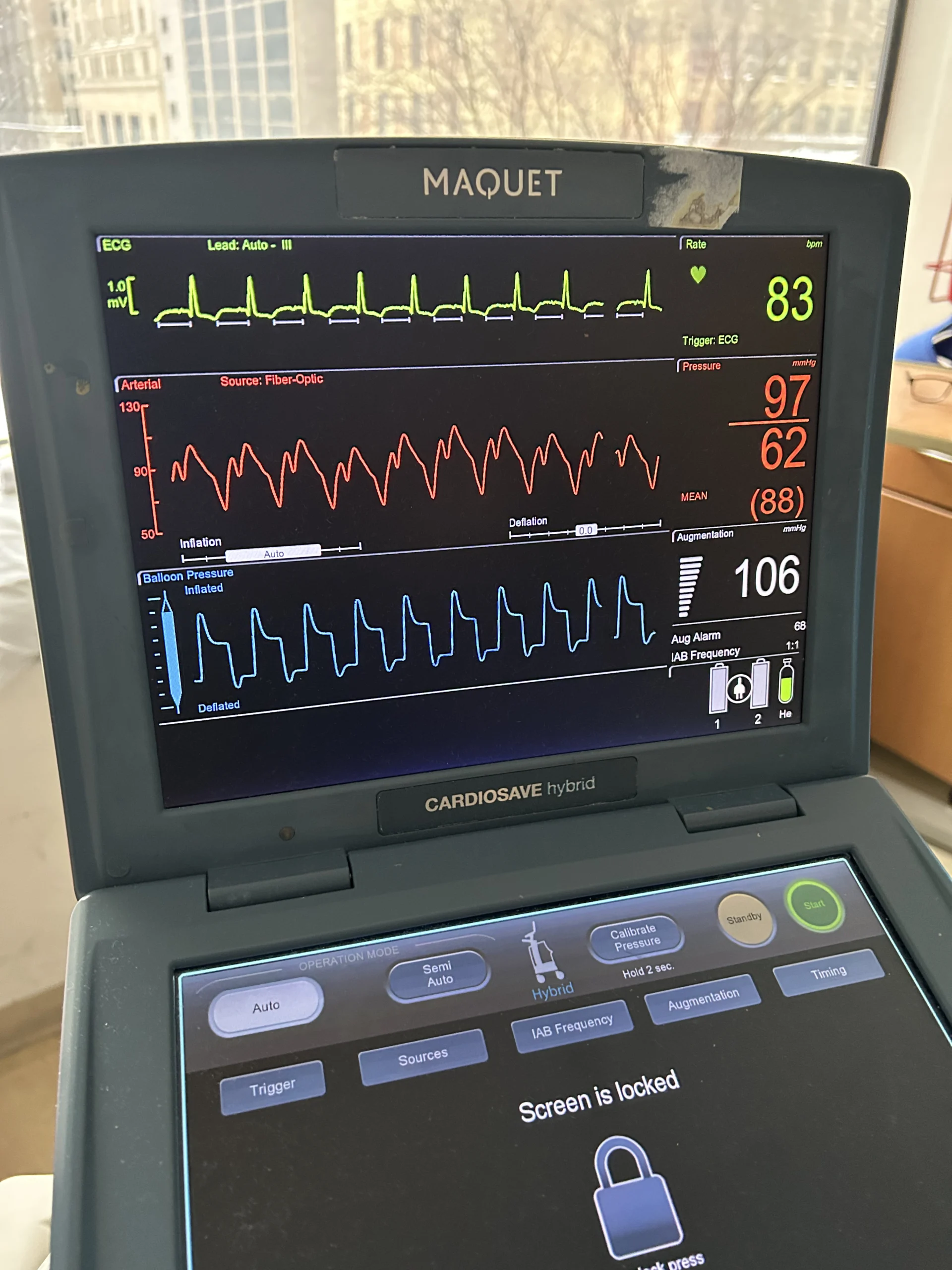
When transport crews are asked to transport a patient with an Intra-Aortic Balloon Pump (IABP), also known as Counterpulsation Therapy, it can strike terror and trepidation in their minds. Let’s see if we can unpack exactly what an IABP device does and how it does it. The purpose of counter pulsation therapy is to achieve 3 goals.
- Increase Coronary Perfusion
- Decrease the workload of the heart
- Improve overall cardiac output
These 3 goals are attained by placing a specialized catheter is typically inserted into the femoral artery and advanced against blood flow until it lies above the renal arteries and below the the left subclavian vein. The catheter itself ranges in length from 60-72 cm and has an inflatable balloon that is timed to inflate just before diastole begins and deflates just before systole begins. The balloon is inflated with helium rather than air or pure oxygen because helium is a thinner gas so it creates less friction with rapid inflation and deflation. Helium is also inert, and therefore, less toxic as it will absorb more rapidly into the patient’s circulation than other gases in the unlikely event of a balloon leak or rupture. These factors make helium the ideal gas to be used for this intervention.
Now let’s take a look at HOW counterpulsation therapy helps to achieve the 3 goals listed above. Counterpulsation therapy increases coronary perfusion(CoPP) by inflating the helium filled balloon just before diastole. Coronary perfusion occurs during the diastolic phase of the cardiac cycle when the aortic valve leaves close to allow the ventricles to fill with blood. Once the aortic valves close, the Coronary Ostia are able to fill with blood. The coronary ostia are located at the base of the Aorta just behind the aortic valves when they are open. Once the coronary ostia are filled with blood, this blood then travels throughout the coronary perfusion system to perfuse the cardiac muscle cells (cardiac myocytes). This increased coronary blood flow achieves the goal of increasing coronary perfusion pressure (C0PP).
Counterpulsation decreases myocardial workload by deflating the balloon just before the systolic phase of the cardiac cycle. This action also decreases myocardial oxygen demand (MV02). By rapidly deflating the helium filled intra-aortic balloon pump catheter, a void is created. The void that is created by the rapid deflation virtually “sucks” the blood from the left ventricle when the aortic valves open and the left ventricle contracts. Rapid balloon deflation also achieves the goal of decreasing the myocardial workload by assisting that left ventricle with emptying more effectively and, as a result, improves overall cardiac output. One of the 4 factors that affect cardiac output is afterload. Afterload is defined as amount of resistance against which the ventricles have to overcome to eject blood from them. This rapid deflation decreases the afterload of the left ventricle by creating that vacuum to assist with ease of blood ejection. Counterpulsation puts the patient at a higher risk for thrombosis so patients are placed on an anti coagulant medication. Placing a patient on anticoagulation therapy also assists with decreasing myocardial oxygen demand by contributing to afterload reduction. It also improves cardiac output by decreasing the blood viscosity which will make the job of perfusing the systemic circulation easier.
Counterpulsation therapy is becoming more and more common and therefore, more ort crews could be exposed to being asked to transport these unique patients. Providers that are educated on the end goals of Intra-aortic Balloon Pump (IABP) therapy can feel more comfortable in transporting these patients. While this is not a daily or even weekly call for transportation, it is an intervention that many EMS providers could be called to transport between facilities. The good news is that most state of the art counterpulsation consoles are very intuitive and require very little manipulation during a routine transport.
In my next blog, we will talk about some of the interventions that may be required during transport.
