
What Is a National Registry “Cognitive Exam” and When Do You Need to Retake It?
EMS providers hear the phrase “cognitive exam” thrown around constantly, but the term gets confused often enough that it’s worth breaking down plainly. Whether you’re a first-time EMT candidate or a Paramedic who hasn’t thought about initial testing in years, knowing exactly what the cognitive exam is, and when it comes back into play, saves a lot of unnecessary stress.
Cognitive Exam vs. Psychomotor Exam
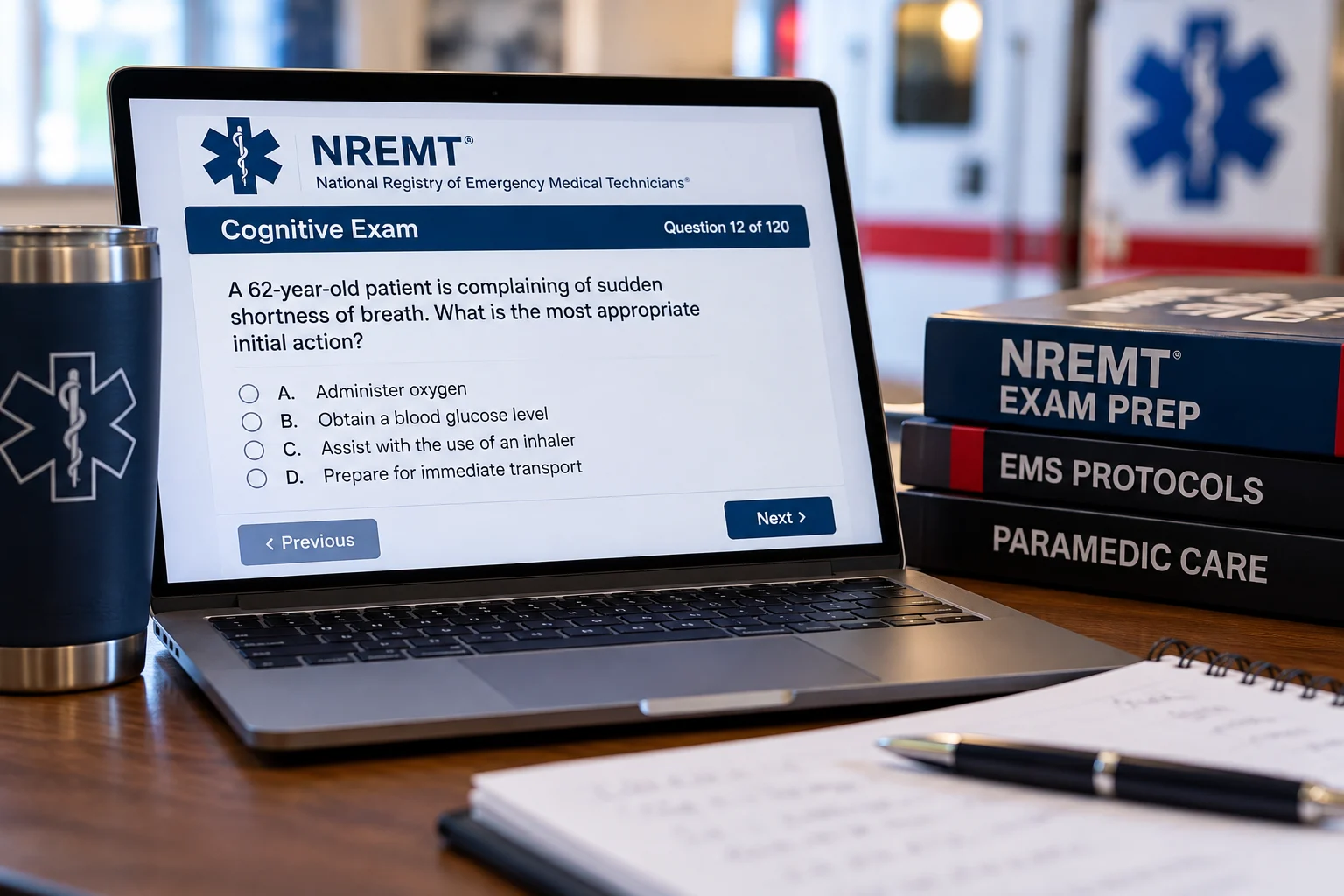
The National Registry of Emergency Medical Technicians (NREMT) certification process for new candidates has two parts: a cognitive exam and a psychomotor exam. The psychomotor exam is the hands-on, skills-based portion, testing things like patient assessment, splinting, and airway management in a practical setting. The cognitive exam is the knowledge-based portion, a computer-adaptive test covering the medical, operational, and clinical decision-making knowledge required at your certification level.
Computer-adaptive means the difficulty of each question adjusts based on how you answer the previous one. Answer correctly, and the next question gets harder. Answer incorrectly, and it adjusts accordingly. The exam ends once the system has enough data to confidently determine whether you’re above or below the passing standard, which is why exam length can vary from one candidate to the next.
When the Cognitive Exam Applies
Initial Certification
Every candidate seeking initial NREMT certification at the EMR, EMT, AEMT, or Paramedic level must pass the cognitive exam as part of the certification process, alongside the psychomotor exam and completion of an accredited education program.
Reinstatement After a Lapse
This is where a lot of confusion happens. Not every lapsed certification requires retaking the cognitive exam. In most standard lapse situations, completing the required continuing education hours for reinstatement is sufficient, without needing to retest. However, extended lapses, particularly ones that stretch well beyond the standard renewal cycle, can trigger a requirement to retake both the cognitive and psychomotor exams as part of reinstatement, depending on how long the certification has been inactive and your state’s specific rules.
Certification Level Upgrades
Moving up a certification level, such as EMT to AEMT or AEMT to Paramedic, requires passing the cognitive exam for that new level after completing the corresponding education program. This is a different scenario than recertification at your current level, since you’re being tested on a new scope of practice entirely.
What the Exam Does Not Cover
Routine recertification at your current level, completed on time with your required continuing education hours, does not require retaking the cognitive exam. This is one of the most common points of confusion for providers who assume every renewal cycle involves retesting. Continuing education hours, not the cognitive exam, are what standard recertification is built around.
Why Providers Get This Wrong
The confusion usually stems from mixing up two very different processes: initial certification testing and ongoing recertification. Initial certification always includes the cognitive exam. Ongoing recertification, done on schedule, typically does not. It’s only when a lapse, an upgrade, or a state-specific requirement enters the picture that the cognitive exam comes back into the conversation.
Preparing for Continuing Education, Not a Retest
For the vast majority of EMR, EMT, AEMT, and Paramedic providers, staying current means completing continuing education hours on time, not preparing for another cognitive exam. DistanceCME offers CAPCE-accredited, 100% online EMS continuing education, delivered through live instructor-led F5 (VILT) courses and self-paced F3 (Distributive) coursework, so completing those hours fits around a work schedule instead of competing with it.
With more live course sessions than any other provider, and a reputation as America’s leading provider of Live NREMT Refreshers, Flight and Critical Care Review Courses, and EMS continuing education, DistanceCME supports EMR, EMT, AEMT, and Paramedic providers through standard renewals as well as the more complicated reinstatement and upgrade situations where the cognitive exam does apply.
Confirming Your Specific Requirement
Because reinstatement and upgrade rules vary by state and by how long a certification has lapsed, the safest move is confirming directly what applies to your specific situation before assuming a retest is or isn’t required. Review the NREMT recertification requirements for your certification level, or contact us and we’ll help you figure out exactly what your path looks like.
.
