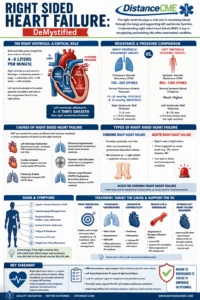

When we typically think about heart failure, most of the time left sided heart failure comes to mind. While it is true that the left ventricle receives the majority of the coronary blood flow and electrical stimulation, the right ventricle plays a large role in supplying blood to the left ventricle after it is pumped to the pulmonary arteries, the lungs, the pulmonary veins and then eventually to the left ventricle after leaving the left atrium. Both ventricles of the heart pump roughly the same volume of blood at 4-8 liters per minute, but the left ventricle has the daunting job of not only perfusing the entire systemic circulation but returning the less oxygenated blood back to the right atrium. The right ventricle is tasked with pumping blood to the lungs and back to the left side of the heart. Resistance to blood flow, or after load, is 4-5 times greater on the left ventricle compared to the the right ventricle. Resistance is measured in “dynes” with the left ventricle pumping against 800-1200 dynes, this is defined as Systemic Vascular Resistance (SVR). The right ventricle only has to pump against 150-250 dynes, this defined as Pulmonary Vascular Resistance (PVR). Normal Pulmonary Arterial Pressures are around 15-25 mm/Hg systolic and 8-12 mm/Hg diastolic compared to the much higher systemic blood pressures. The right ventricular wall is approximately 1/3 the thickness of the left ventricular wall at 3-5 mm while the left ventricular wall measures roughly 8-12 mm in thickness.
Right ventricular dysfunction can result from multiple causes. Left ventricular dysfunction is the most common cause as it results in an overall increase in PVR due to the fact that both ventricles are charged with pumping the same volume of blood over time. If the left ventricle cannot keep up with the volume of blood being pumped by the right ventricle, blood will begin to back up and, as a result, the PVR will increase over time. Interestingly, if the right ventricle then begins to fail, often the left sided heart failure signs and symptoms will diminish due to the fact that the right ventricle no longer supplies the left side of the heart with the same volume of blood. Other causes of right sided heart failure can be cardiac ischemia, pulmonary emboli, persistent pulmonary hypertension due to vasoconstriction of the pulmonary blood vessels, pulmonic valve disorders and chronic obstructive pulmonary disorders like Emphysema, Bronchitis and/or Asthma. All of these conditions will impede the ejection of blood via the right ventricle and therefore increase the overall workload of the weaker right ventricle. Right ventricular failure can be classified as either acute, if onset is rapid, or chronic, if the issue occurs over time. Chronic right ventricular failure is often accompanied by generalized dependent edema. As the right ventricle is not able to function as efficiently as it has in the past, blood backs up into the right atrium and then eventually into the systemic vasculature. Acute on chronic right ventricular failure is when the underlying right ventricular dysfunction is exacerbated or aggravated by an insult to the heart itself.
Treatment for right sided heart failure often involves identifying and correcting the underlying root cause. Sometimes eliminating the underlying cause is impossible, so minimizing the effects of the underlying cause can often improve the symptoms. Pulmonary vasodilators like Nitric Oxide and Epoprostenol can be prescribed to dilate the pulmonary blood vessels and decreasing the overall workload of the right ventricle. There are multiple medications that can be prescribed to treat right ventricular dysfunction itself. Medications such as Amrinone and Dobutamine can increase the overall performance of the right ventricle while medications like Sildenafil will cause pulmonary vasodilation. Angiotensin II receptor blockers (ARB’s) can be prescribed to not only lower the pulmonary vascular resistance but also help with right ventricular remodeling and slowing the progression of right ventricular enlargement. Improving left sided heart failure will also improve the strain on the right ventricle so common left sided heart failure meds may be prescribed.
As you can see, multiple forces can work against the overall effectiveness of the right ventricle both acutely and chronically. There are multiple treatment modalities that can be used simultaneously to improve overall function. While we usually think of left ventricular failure when we hear the term heart failure, this is not always the case. Improving any outflow obstructions or resistance, will assist with improving the function of the function of the cardiovascular system.