
Mass Gathering Medicine: What EMS Providers Need to Know Before Working a Fireworks Event
Every summer, millions of Americans gather in parks, fairgrounds, and stadiums to celebrate the Fourth of July. Behind the fireworks and the food trucks, EMS teams are quietly pre-positioning, coordinating with incident command, and bracing for what experience tells them is coming. Mass gathering medicine is a subspecialty all its own, and providers who walk into a large-scale event without understanding its unique demands are already a step behind.
Whether you are a seasoned paramedic who has staffed dozens of these events or an EMT preparing for your first summer festival deployment, this guide covers the core principles and practical preparation steps that make the difference between an organized response and a chaotic one.
What Makes Mass Gatherings Different from Routine EMS
On a typical shift, EMS resources are distributed across a service area and dispatched one call at a time. At a mass gathering, everything is compressed. Thousands of patients move through a confined space, access routes are restricted, and the incident command structure has to function without the luxury of time or easy communication.
Mass gathering events are generally defined as planned events where 1,000 or more people convene in a single location. At the scale of a major Fourth of July celebration, attendance can reach tens or even hundreds of thousands. The density of people alone changes the risk profile for every patient contact.
Key differences EMS providers must anticipate include delayed scene access, limited egress for ambulances, crowd noise that affects communication, high patient volumes arriving simultaneously, and the psychological challenge of making triage decisions in plain sight of large crowds.
The Most Common Calls at Fourth of July Events
Heat Illness
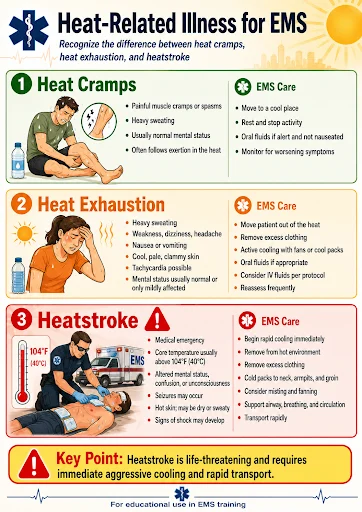
Summer events mean sun exposure, inadequate fluid intake, and physical exertion. Heat exhaustion and heat stroke are predictable and preventable, but they still send patients to the hospital every year. Providers should know the staging of heat illness and be prepared to initiate aggressive cooling before transport. The provider section of this blog discusses hydration for the crew, but heat illness in patients is a clinical priority that demands rapid recognition and treatment.
Alcohol and Substance-Related Calls
Alcohol is part of the culture at many summer events. Intoxicated patients present with a wide range of complaints, from minor falls and lacerations to altered mental status, aspiration risk, and polysubstance complications. Crowd dynamics also mean that conflicts and assaults are more likely. Providers should be familiar with local protocols for patient refusal in altered states and documentation standards that protect both the patient and the provider.
Crowd Crush and Traumatic Injury
Crowd crush events are rare but catastrophic. Sudden crowd surges, particularly during fireworks ignition or when performers take a stage, can trap individuals against barriers and cause compressive asphyxia even in people who remain standing. Providers should understand the signs of crowd crush injury, which do not always look like classic trauma, and have a clear plan for mass casualty triage if an event deteriorates rapidly.
Minor traumatic injuries, including lacerations from fireworks debris, ankle sprains from uneven terrain, and blunt trauma from falls in crowded areas, are far more common and should be triaged and tracked efficiently to preserve resources for higher-acuity patients.
Pediatric and Vulnerable Population Calls
Children, elderly attendees, and individuals with chronic health conditions are disproportionately represented in mass gathering patient populations. Pediatric patients at Fourth of July events may present with fireworks burns, febrile illness from heat exposure, or anxiety reactions to loud noise. Providers should have pediatric dosing references available and be familiar with protocols for unaccompanied minors.
Crowd Crush: Understanding Compressive Asphyxia
Crowd crush deserves a deeper look because the physiology is counterintuitive. Victims of compressive asphyxia can remain upright, conscious, and verbally responsive even while experiencing fatal compression. The weight of a dense crowd exerts pressure on the chest that prevents adequate ventilation, even though the airway remains open.
Providers responding to a crowd crush event should prioritize rapid extrication, airway management, and high-flow oxygen. Patients who appear minimally symptomatic at extrication may deteriorate rapidly. All patients involved in a crowd crush event should be transported for evaluation regardless of initial presentation.
Patient Access Challenges in Dense Crowds
Getting to a patient in a crowd is one of the most underestimated challenges in mass gathering medicine. Standard ambulance access is rarely possible in the interior of a large venue. Most mass gathering EMS plans rely on foot teams, golf carts or utility vehicles, and staged treatment areas positioned at intervals around the event footprint.
Providers should walk the event layout before the crowd arrives whenever possible. Identify treatment area locations, ingress and egress routes for evacuation vehicles, the location of the incident command post, and communication dead zones where radio coverage is unreliable.
Practical Preparation Checklist for EMS Providers
Before the first patient contact, every provider staffing a Fourth of July or summer mass gathering event should complete the following:
Review the event-specific medical operations plan, including patient load projections, treatment area locations, and hospital diversion policies. Verify communication protocols and confirm radio frequencies and backup communication options. Know the chain of command and who to contact for air medical activation, additional resources, or declaration of a mass casualty incident.
Inspect all equipment before deployment, including cooling supplies, IV materials, airway equipment, and pediatric kits. Confirm that adequate supplies for heat illness treatment are staged in each treatment area. Brief your partner or team on expected patient presentations and your triage process.
Hydrate before your shift begins and establish a crew rotation plan that includes breaks for fluid intake and rest. Provider heat stress is a real operational risk, and a crew that is not managing its own health cannot effectively manage patients.
Continuing Education Keeps You Ready
Mass gathering medicine is one of many advanced clinical areas covered in EMS continuing education. Providers who complete regular CE are better equipped to handle the high-acuity, low-frequency calls that define events like these. DistanceCME offers CAPCE-accredited EMS continuing education through fully online, live instructor-led F5 (VILT) formats as well as self-paced F3 distributive courses, so providers can stay current without disrupting their schedules.
As America’s leading provider of live NREMT Refreshers, Flight and Critical Care Review Courses, and comprehensive EMS CE, DistanceCME carries more live course options than any other provider, giving you the flexibility to complete your required hours on your timeline. Whether you hold an EMR, EMT, AEMT, or Paramedic certification, you can use the course search feature at DistanceCME to find exactly what you need, or reach out directly and the team will help you find and book the right course for your certification level and renewal deadline.
Mass gathering events are one of the most rewarding and demanding deployments in EMS. Showing up prepared, informed, and CE-current is how you give every patient the best possible chance.
