
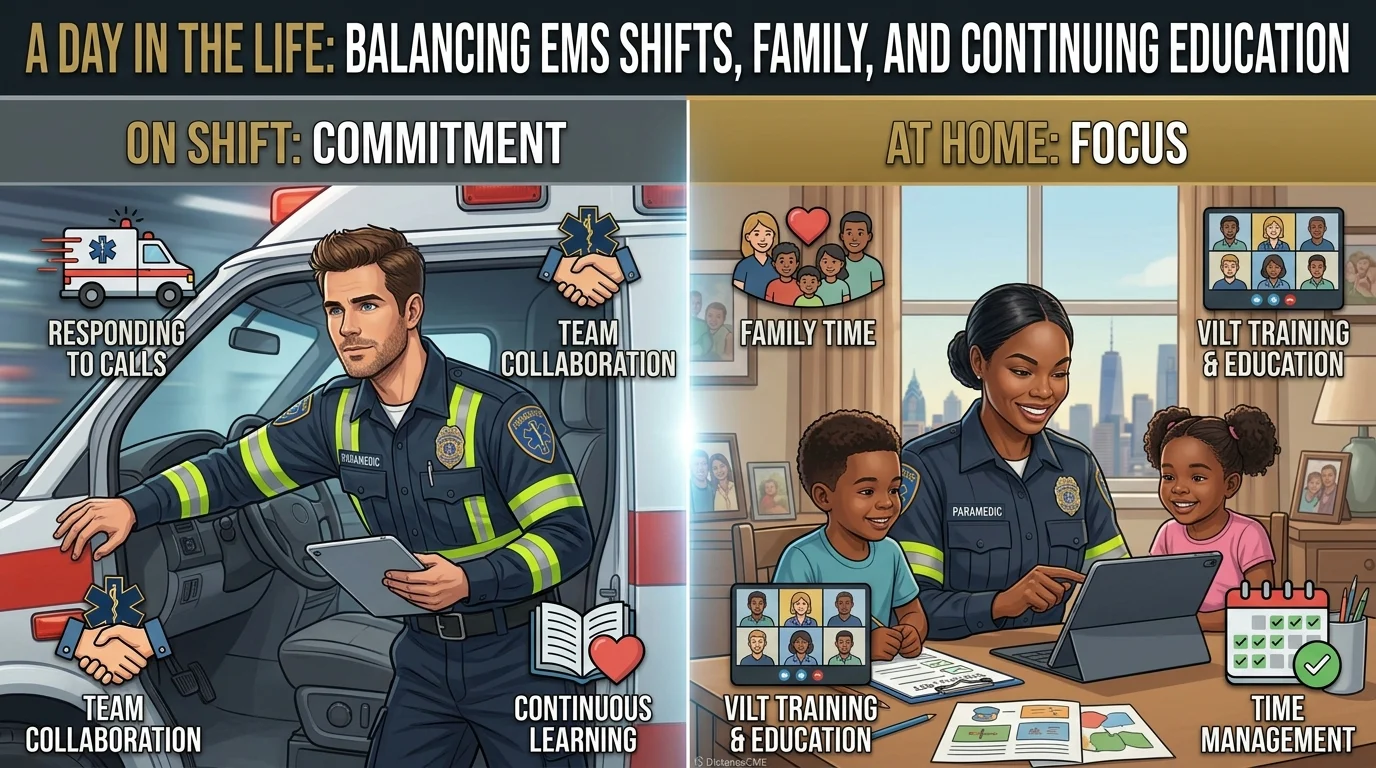
Ask any EMT or paramedic how they spend a “typical” week, and you will usually get a slightly exhausted laugh before the real answer comes out. Between rotating shifts, unpredictable overtime, family obligations, and the ever-present continuing education clock ticking toward the next recertification deadline, there is no such thing as a truly typical week in EMS. Here is what that balancing act actually looks like, and how providers make it work.
The Shift That Never Quite Ends on Time
A 24-hour shift is supposed to end at a set time. In practice, a call that comes in at 6:45 in the morning for a 7:00 handoff means a provider is walking through their front door two, three, sometimes four hours later than planned. Multiply that by a few shifts a month and the ripple effect on everything else, sleep, family plans, appointments, becomes obvious fast.
Morning: Handoff and the Drive Home
For providers working 24-hour or 12-hour shifts, the drive home is often when the mental load of the shift finally starts to lift. Sleep debt from a busy night, the emotional weight of a hard call, or simply the physical exhaustion of being on your feet for hours all come home in the car with you. Many providers describe needing a buffer, even just twenty minutes of quiet, before walking into a house full of kids who have been waiting to see them.
Midday: Family Time Squeezed Into Odd Hours
Because EMS schedules rarely line up with a standard nine-to-five, family time often happens at unusual hours. School pickup after a night shift, dinner together before a 24-hour rotation starts, or a weekday afternoon at the park while the rest of the working world is at the office. Providers with kids often describe getting good at packing meaningful time into smaller windows, since the windows themselves are frequently the only thing available.
Where Continuing Education Actually Fits
This is where a lot of providers hit a wall. Recertification hours do not pause for a busy month, a sick kid, or a stretch of mandatory overtime. Depending on certification level, providers are working toward 16, 40, 50, or 60 hours of continuing education every two years, and those hours have to get logged somewhere in a schedule that already feels full.
Fitting Hours Into Real Life, Not an Ideal Schedule
The providers who stay ahead of their continuing education deadlines are rarely the ones who found extra free time. They are the ones who built small, repeatable habits around it. Thirty minutes on a self-paced module after the kids go to bed. A live virtual class scheduled on a known day off instead of squeezed in as an afterthought. A lunch break at the station used for a short module instead of scrolling a phone.
Choosing Formats That Match Your Actual Schedule
Providers on rotating shifts often find self-paced, on-demand courses easier to manage, since they can log in whenever a pocket of time opens up rather than committing to a fixed class window. Providers with more predictable schedules sometimes prefer live, instructor-led sessions, since the set time actually helps them protect the hours from getting pushed aside by everything else competing for attention.
Evenings: What Recovery Actually Looks Like
The best version of an evening after a rough shift usually is not complicated. Dinner with family, a workout, time outside, or simply going to bed early all show up repeatedly when providers talk about what actually helps them reset. The providers who manage a long EMS career well tend to protect this recovery time deliberately, treating it as part of the job rather than an afterthought squeezed in whenever nothing else needs doing.
Making the Balance Sustainable
There is no perfect formula for balancing EMS shifts, family life, and continuing education. What works is finding a rhythm that fits your specific schedule, rather than trying to force your life around a training model built for someone else’s shift pattern. DistanceCME offers CAPCE-accredited, 100% online, live instructor-led F5 (VILT) and self-paced F3 (Distributive) EMS CE, with more live courses than any other provider, so you can build your recertification hours around your actual life instead of the other way around. As a leading provider of Live NREMT Refreshers, Flight and Critical Care Review Courses, and EMS continuing education, we offer EMR, EMT, AEMT, and Paramedic Refreshers along with a full range of online EMS training built for providers juggling everything EMS asks of them. Use our search feature to find a course that fits your schedule, or contact us and we will help you find the right one.
