
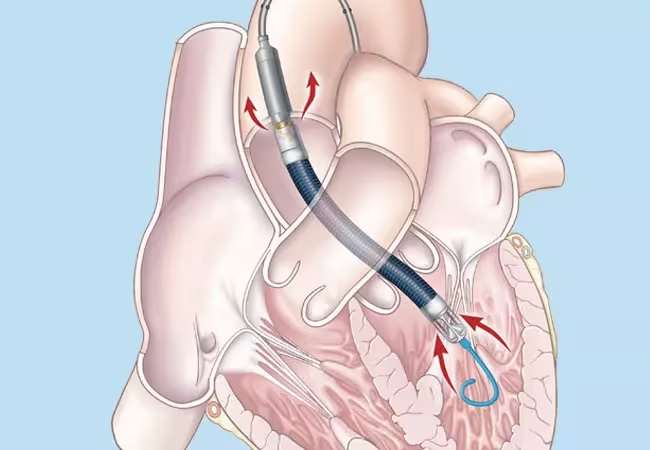
When we think about cardiac assist devices, our minds often immediately go to Left Ventricular Assist Devices (or LVADs) and/or Intra Aortic Balloon Pumps (IABP). A close cousin to the LVAD that we are talking about today is the Impella device. The Impella device is a temporary, catheter based, percutaneously inserted cardiac assist device that provides continuous flow via a micro-axial pump. It provides not only temporary support of hemodynamics but also supports cardiac function to a patient with decreased ventricular function and can improve perfusion to the coronary muscles. While the Impella can provide support to either the left or right ventricle, the majority of devices are utilized for left ventricular insufficiency. The percutaneous catheter is most often inserted into the femoral artery and fed retrograde (or against the blood flow) up the aorta and past the aortic arch. The catheter itself comes to rest and is secured across the aortic valve with the inlet valve in the ventricle and the outlet valve in the ascending aorta. The Impella device is designed to pull blood from the ventricle to the aorta, therefore assisting with ventricular offloading and improving cardiac output while decreasing myocardial workload. The increase in overall blood flow from the left ventricle has been shown to improve myocardial muscle oxygenation.
Impella devices are utilized in patients that are undergoing high risk percutaneous catheter insertion (PCI) procedures and patients that are suffering from cardiogenic shock that is refractory to routine interventions aimed at improving cardiac output. Cardiogenic shock can be due to post myocardial infarction, infectious processes like myocarditis, decompensated heart failure or after open heart surgery during the recovery phase. The Impella is often inserted to provide temporary cardiovascular support without the risks associated with surgical insertion needed for traditional LVAD devices and can remain in place for days to weeks. The device flow rate can be adjusted to meet the patient’s specific needs while inserted.

The most common type of Impella device is the Impella CP. The Impella CP uses a 14 French catheter for the device and a 9 French catheter for the remainder of the device shaft. Maximum flow rates of 4.3 liters/minute are obtainable with Impella CP. The Impella 5.5 is able to provide a larger cardiac output at 5.5 liters/minute via a 21 French catheter across the aortic valve with a 9 French catheter for the rest of the shaft. The Impella 5.5 if usually placed surgically in the axillary artery, most often in the patient’s right arm. For right ventricular support, the Impella RP is used. This device supports not only right ventricular function but also improves right pulmonary arterial circulation. The catheter for the RP is a 21 French while the shaft is an 11 French diameter. Insertion for the Impella RP is accomplished by inserting the device via the femoral vein and feeding the up the inferior vena cava, past the right atrium, the tricuspid valve, the right ventricle, the pulmonic valve and coming to rest in the pulmonary artery. The distal outflow end of the Impella RP is located in the pulmonary artery and the proximal inflow end is often located either in the right atrium or in the inferior vena cava. The device frequently lies across both the tricuspid and pulmonic valves. Impella RP devices can obtain flow rates of up to 4 liters/minute and can be used independently or with an Impella left ventricular assist device.
Impella devices come in multiple configurations and capacities that can be used to augment either left or right ventricular function. It also has been shown to decrease myocardial oxygen demand and improve coronary perfusion pressures. The device itself can often be inserted percutaneously and avoids many of the risks associated with other ventricular assist devices that require surgical implantation. While the device is considered a “temporary” alternative, it can remain in place for weeks if necessary. It is yet one more alternative or tool in the cardiologist’s tool kit and when used at the appropriate time for the appropriate reason has been shown to improve morbidity and mortality while avoiding the risks and complications associated with some other cardiac assist devices.
